
The Trap of Obviousness-Type Double Patenting When the Reference Case Has Different Ownership
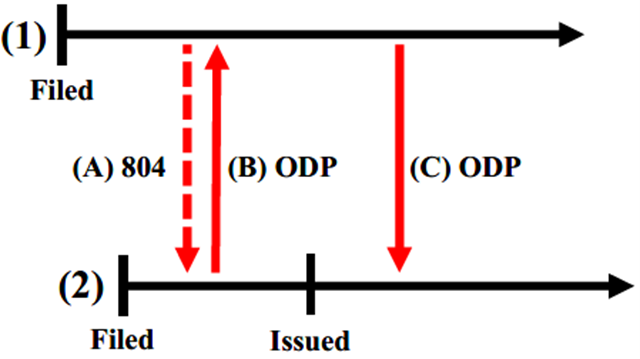
An obviousness-type double patenting rejection (“ODP”) over a reference patent or application with a different ownership entity creates a trap for the unwary: the Patent Office can make an ODP rejection over a patent issued to a co-owner or a joint inventor, but a terminal disclaimer cannot be filed to overcome the ODP rejection because the ownership entity is different[1]. There are at least three scenarios involving this trap. First, and simplest for the applicant, when the reference case is the second-filed application, the ODP rejection is provisional and can be removed under MPEP § 804(I)(B)(1)(b)(i) (the “(A)” scenario). Second, when the reference case is the first-filed application or patent (“(B)”), the only option to overcome the rejection is to demonstrate that the claims are patentably distinct, i.e., claim a different invention.[2] And third, when the reference case is the second-filed patent (“(C)”), the options to overcome the rejection are to demonstrate that the claims are patentably distinct, or satisfy the two-way test for distinctness.[3] These scenarios highlight the risk to each application. An ODP rejection is expected in the second-filed application over the first-filed application, making the odds long a second-filed patent will be granted in scenario (B). But if no such ODP rejection is made and the second-filed application issues first, the second-filed patent is the sole patent, i.e., the “a patent”, allowed under 35 U.S.C. § 101[4], and the long odds of securing a patent shifts to the first-filed application.
Case law demonstrates the long odds for first-filed applications that are not first-issued.
In re Hubbell[5], a 2013 Federal Circuit decision, and its enduring precedent highlights the long odds for first-filed applications under scenario (C). Hubbell involved inventors at the California Institute of Technology (Caltech), including Hubbell, who moved to ETH Zurich and continued research regarding tissue repair and regeneration. Caltech filed a patent application in 2003 listing Hubbell as an inventor, claiming priority to 1997 via several continuation applications. ETH filed a patent application in 2002 also listing Hubbell as an inventor, and claiming priority to 1998 via several continuation applications. The ETH patent issued in 2009, with claims drawn to patentably indistinct subject matter from that claimed in the Caltech application. Thus, the resulting ETH patent was second-filed, and first-issued. No ODP rejection was made in the ETH application over the Caltech application. After the ETH patent granted, an ODP rejection was made in the first-filed Caltech application over the second-filed and first-issued ETH patent. While affirming the ODP rejection against the Caltech application, the Hubbell court highlighted the risk of multiple lawsuits by different assignees: “the potential for harassment by multiple assignees would exist because an infringer of claim 1 of the [ETH] patent would also infringe at least rejected claim 18 [of the Caltech patent application].” Hubbell, at 1147. The Hubbell court also pointed to the 2009 Federal Circuit decision In re Fallaux[6], noting that “the harassment justification is ‘particularly pertinent’ in cases where, as here, the application and the conflicting patent are not commonly owned.” Hubbell, at 1148. Thus, without any risk of an unjustified time-wise extension of patent term, the Hubbell court affirmed the ODP rejection against the first-filed Caltech application over the second-filed and first-issued ETH patent.
Fallaux involved a similar fact pattern as in Hubbell, except that the different ownership in Fallaux was the result of an assignment of the second-filed patent to the second owner by the owner of the first-filed application. The Fallaux court noted that the public policy against unjustified time-wise extension of patent term “has limited force in this case” because the reference patent has a later filing date and later expiration date than the first-filed application at issue. (Fallaux, at 1318). Instead, the Fallaux court focused on the second public policy concern of multiple lawsuits by different assignees, noting that the “harassment justification for obviousness-type double patenting is particularly pertinent here” given the different ownership, while affirming the ODP rejection over the second-filed and first-issued patent. (Fallaux, at 1319.)
The USPTO Patent Trial and Appeal Board (“PTAB”) recently relied on Fallaux in the appeal Ex Parte Baumeister[7], to affirm an ODP rejection of the first-filed application over several second-filed and first-issued patents having different ownership than the first-filed application. In doing so, the PTAB distinguished the double patenting case law involving patents having common ownership.[8] The applicant in Baumeister also tried to rely on and extend the PTAB’s decision in Ex Parte Baurin[9] as purported precedent to reverse the ODP rejection (discussed in our 2024 article A Later-Filed, Later-Expiring Unrelated Patent is Not a Proper Reference Patent for an Obviousness-Type Double Patenting Rejection). Ex Parte Baurin reversed an ODP rejection over a later-filed, later-expiring, unrelated, and commonly-owned reference patent. Given these differences from Baumeister, Ex Parte Baurin was not considered by the Baumeister board. The applicant in Baumeister appealed the decision to the Federal Circuit in January 2026.
Demonstrating the difficulty of not being the first-issued patent in a Hubbell scenario, each applicant in Baumeister, Hubbell, and Fallaux was forced to rely upon and argue that the narrow two-way test for distinctness should be applied.[10] Satisfying this test under MPEP § 804(II)(B)(5) requires conditions where “the applicant could not have filed the claims in a single application and the Office is solely responsible for any delays.” “Unless the record clearly shows administrative delay caused solely by the Office and that applicant could not have avoided filing separate applications, the examiner may use the one-way distinctness determination and shift the burden to applicant to show why a two-way distinctness determination is required.” (MPEP § 804(II)(B)(5).) The applications at issue in each of Baumeister, Hubbell, and Fallaux, however, were continuation applications. As a result, each applicant was found to be at least partly responsible for the delays, meaning that the Office was not solely responsible as required, and the two-way test for distinctness was not applicable. Given its strict requirements, the two-way test is rarely a realistic option to overcoming an ODP rejection in a Hubbell scenario.[11] The only realistic option in these situations is amending the claims to a different scope to be patentably distinct, a wholly unsatisfying option.
Fundamental principles of ODP necessitate rejecting the first-filed but not first-issued differently owned application.
The focus on “first-issued” for patents with different ownership is similar to the focus for commonly-owned patents with a shared priority date (the “continuation scenario” discussed in our article from 2024: A Continuation Application is an Implicit Admission of Obviousness-Type Double Patenting When Filed from a Parent Patent). This is because the “first-issued” patent is the “a patent” under § 101 in both the continuation scenario and the Hubbell scenario.[12] It stands in contrast with the “first-filed” standard set by the Federal Circuit in Gilead v. Natco, which held that when the ownership is the same and there are different priority dates, the “a patent” is the one with the earlier 20-year expiration date, i.e., the “first-filed”.[13] The concern expressed in Gilead was one of “gamesmanship”, where the patent owner could manipulate the priority filing dates and prosecution of the two applications to ensure that the second-filed application issued as a patent before the first-filed application, thereby extending the 20-year patent term. (Gilead, at 1215-16, as discussed in our 2024 article: The New Rubric for Obviousness-Type Double Patenting.) Because the two patents in the “continuation scenario” are co-owned and share the same priority date, there is no issue of such “gamesmanship” extending the patent term.[14] Similarly, the different ownership in the Hubbell scenario substantially reduces the risk of any “gamesmanship” since no single owner can influence the filing dates and rate of prosecution of the two applications.
Despite these clear principles, some commentators have argued ODP should not be found in cases such as Baumeister because the public policy of an unjustified time wise extension of patent term, often referred to as the “fundamental principle” of ODP[15], is not at issue. This perspective, however, overlooks the fundamental principle of the patent system, which mandates that upon the expiration of a patent, whether at the end of the 20-year term or before, the public is free to use the invention and obvious modifications thereof. “Where, as here, the claimed subject matter is an obvious modification of what has already been claimed, a second patent is contrary to one of the fundamental principles underlying the patent system, namely, that when the right to exclude granted by a patent expires at the end of the patent term, the public shall be free to use the invention as well as obvious modifications thereof or obvious improvements thereon. Thus, granting a second patent for an obvious variation deprives the public of those rights.”[16] Moreover, the public policy concern of preventing multiple suits by different patent owners is equally fundamental to obviousness-type double patenting, and allowing a second patent to issue in the Hubbell scenario, even if first-filed and earlier expiring, would run afoul of these fundamental principles.
Summary
Baumeister, Hubbell, and Fallaux highlight the risk to the first-filed application: if the second-filed application issues first, and there are any prosecution delays attributable to the applicant, then overcoming the ODP rejection via MPEP § 804(I)(B)(1)(b)(i) and the two-way test for distinctness are unavailable. For the second-filed application, the odds of issuance are long because an ODP rejection is expected over the first-filed application, and the public policy concerns of an unjustified timewise extension of patent term and multiple lawsuits by different assignees both apply. But if no ODP rejection is made in the second-filed application, what issues is the sole patent to the invention, the “a patent” under § 101, and the long odds of securing a patent shifts to the first-filed application. “Where the claims of a second application are substantially the same as those of the first patent, they are barred under 35 U.S.C. 101.”12 Thus, the first-filed application in the Hubbell scenario should be prosecuted to grant as quickly as possible or risk not obtaining a patent at all.
[1] 37 CFR § 1.321; MPEP §§ 804, 1490.
[2] Scenario (B) is the only applicable option when the two applications have the same filing date.
[3] MPEP § 804(II)(B)(5): The two-way test for distinctness requires finding obviousness twice, “first analyzing the obviousness of the application claims in view of the patent claims, and then analyzing the obviousness of the patent claims in view of the application claims.”
[4] 35 U.S.C. § 101: Whoever invents or discovers any new and useful process, machine, manufacture, or composition of matter, or any new and useful improvement thereof, may obtain a patent therefor, subject to the conditions and requirements of this title.
[5]In re Hubbell, 709 F.3d 1140 (Fed. Cir. 2013).
[6]In re Fallaux, 564 F.3d 1313, 1319 (Fed. Cir. 2009).
[7]Ex Parte Baumeister, Appeal 2026-000193, Application 17/409,019 (PTAB Nov. 21, 2025).
[8]Ex Parte Baumeister, at 5-8, citing Allergan USA, Inc. v. MSN Labs. Private Ltd., 111 F.4th 1358 (Fed. Cir. 2024); In re Cellect, LLC, 81 F.4th 1216 (Fed. Cir. 2023); Novartis AG v. Ezra Ventures LLC, 909 F.3d 1367 (Fed. Cir. 2018); Novartis Pharms. Corp. v. Breckenridge Pharm. Inc., 909 F.3d 1355 (Fed. Cir. 2018); Gilead Sciences, Inc. v. Natco Pharma Ltd., 753 F.3d 1208 (Fed. Cir. 2014); Acadia Pharmaceuticals Inc. v. Aurobindo Pharma Ltd., 706 F.Supp.3d 477 (D. Del. 2023), aff’d, 2025 LEXIS 14044 (Fed. Cir. June 9, 2025).
[9]Ex Parte Baurin, Appeal 2024-002920, Application 17/135,529 (PTAB Nov. 6, 2024); Ex Parte Baurin, Decision on Request for Rehearing, Appeal 2024-002920, Application 17/135,529 (PTAB Dec. 18, 2025).
[10]Ex Parte Baumeister, at 8-12; In re Hubbell, at 1149-50; In re Fallaux, at 1316-18.
[11] E.g., where claims entered in the first-filed application rather than a continuation application, without any delays in prosecution being incurred by applicant, such as taking any extensions of time.
[12] “Where the claims of a second application are substantially the same as those of the first patent, they are barred under 35 U.S.C. 101. In re Ockert, 44 CCPA 1024, 245 F.2d 467, 114 USPQ 330. Miller v. Eagle Mfg. Co., 151 U.S.C. 186, (1894).” In re Robeson, 331 F.2d 610, 614 (CCPA 1965). “35 U.S.C. 101 … provides that an inventor may obtain a patent for his invention. There is no statutory provision for the granting of a plurality of patents on a single invention, and this court has repeatedly held that if two patents are to be granted there must be two inventions. In re Jennings. 35 C.C.P.A. (Patents) 1163, 167 F.2d 1014, 77 USPQ 613; In re Ward et al., 43 C.C.P.A. (Patents) 1007, 236 F.2d 428, 111 USPQ 101, and cases there cited.” In re Ockert, 245 F.2d 467, 469 (CCPA 1957).
[13] Gilead Scis., Inc. v. Natco Pharma Ltd., 753 F.3d 1208, 1217 (Fed. Cir. 2014).
[14] Allergan USA, Inc. v. MSN Labs. Private Ltd., 111 F.4th 1358, 1370 (Fed. Cir. 2024); Novartis Pharms. Corp. v. Breckenridge Pharm. Inc., 909 F.3d 1355, 1364 (Fed. Cir. 2018).
[15] In re Van Ornum, 686 F.2d 937, 943-44 (CCPA 1982).
[16] In re Robeson, 331 F.2d 610, 614 (CCPA 1965), citing Singer Mfg. Co. v. June Mfg. Co., 163 U.S. 169, 195 (1896) (“It is self evident that on the expiration of a patent the monopoly created by it ceases to exist, and the right to make the thing formerly covered by the patent becomes public property. It is upon this condition that the patent is granted.”)
Author