Ex Parte Reexamination: The Patent Owner StrategyA practical guide for patent owners facing reexamination
For more than a decade, inter partes review (IPR) was the tool of choice for trying to invalidate a patent. That is changing. As the USPTO tightens the gate on IPRs, some challengers are turning to an older tool — ex parte reexamination — and patent owners are increasingly finding their patents under attack through a process that is fundamentally different from IPR proceedings and requires fundamentally different strategies.
Reexamination lives in the space between IPR proceedings and traditional prosecution. In this article, we discuss why some are pivoting from IPR proceedings to ex parte reexaminations, how reexamination differs from IPR through a litigation lens, what unique defensive options are available, and which strategies may give a patent owner the best chance of coming out ahead.
The Pivot to Ex Parte Reexamination
Ex parte reexamination is an old procedure enjoying a new surge in popularity, and the reason why is straightforward: the USPTO has sharply expanded its use of discretionary denials to keep IPR petitions from being instituted in the first place.
IPR earned its reputation as the challenger's tool of choice because it works. Of the petitions that reached a final written decision, 84% ended with at least some claims found unpatentable, and 64.6% ended with every challenged claim found unpatentable.[1] Those are daunting numbers if you are the patent owner on the receiving end of a petition.
But the landscape has shifted. Director Squires and his delegates now make every IPR institution decision,[2] and the USPTO has proposed rules that would cut IPRs off from co-pending and future litigation in other forums entirely.[3] In short, the path into an IPR has narrowed considerably.
Faced with a tighter IPR door, more challengers are pivoting to ex parte reexaminations. Prior to IPRs, ex parte reexaminations were a reliable path to challenge validity. In 2012, when IPR proceedings were created, reexaminations were at an all-time high. The 2012 peak collapsed as challengers shifted to the new inter partes review and post-grant review proceedings — falling to 305 the very next year and grinding down to a low of 163 in fiscal 2019. The tide began to slowly turn in 2020 as the PTAB's discretionary denials of IPR petitions pushed defendants back toward reexamination.
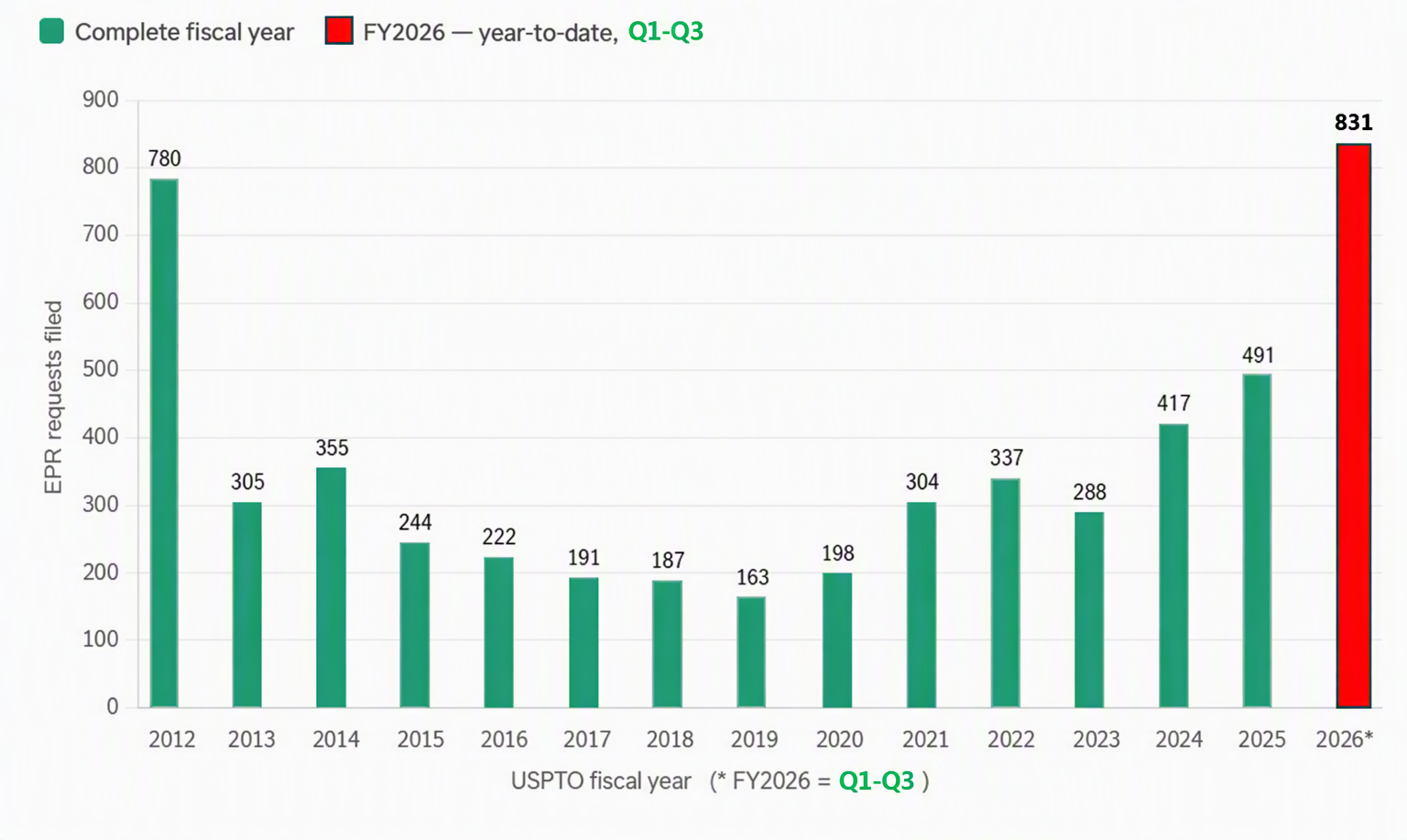
Ex parte reexamination requests that received a filing date, by USPTO fiscal year (Oct – Sep).
Sources: USPTO historical statistics (FY2012 – FY2025, data as of 9/30/2025) and operational statistics (FY2026 Q1, data as of 1/5/2026).
The standout here is the red bar representing the first three quarters of 2026, which already has more reexamination requests than every complete fiscal year from 2012 through 2025. If the reexamination requests maintain pace, FY2026 would annualize to roughly 1,100 filings. After a post-AIA decline, reexamination is at record levels, driven largely by practitioners treating it as the more reliable alternative to an increasingly hard-to-access PTAB.
Reexamination vs. IPR
As outlined in this section, there are significant differences (and some similarities) between ex parte reexaminations and IPRs.
Ex Parte
Reexamination is ex parte, meaning the challenger has far less participation in the proceedings as compared to IPRs, and as a result, the reexamination proceedings are less akin to litigation. Compared to IPRs, there are no depositions, no discovery, no motion practice, and no extended sparring with opposing counsel. Once the proceeding is underway, all communications run to the USPTO.
Parallel Litigation
Parallel litigation, especially in later stages, could be a showstopper for instituting an IPR. The Director may apply discretion to decide whether to institute an IPR with pending litigation. Based on the chart above, the Director has broadly applied this discretionary power. But reexaminations run on a different track. Under 35 U.S.C. § 305, the USPTO generally will not delay or stay a reexamination just because a parallel court case is underway.[4] This means the Director may not have or exercise the same discretionary power and the Office will press ahead regardless of pending litigation.
Limited Ability to Amend in IPR
In an IPR, it is very difficult to amend your claims. Every substitute claim faces an actively adverse petitioner who will fight it with prior art and expert testimony. Historically, very few motions to amend have succeeded. Additionally, you cannot increase the total claim count. Under 35 U.S.C. § 316(d), a patent owner may cancel challenged claims and propose only “a reasonable number of substitute claims” — presumptively one substitute for each challenged claim — and those substitutes may not enlarge claim scope or add new matter.
Reexamination Reopens Prosecution, Including Ability to Amend and Add New Claims
Because reexamination reopens prosecution, the patent owner may add an unlimited number of new claims, so long as they do not broaden the scope of your existing claims. And the person evaluating those claims is a panel of examiners at the Central Reexamination Unit, not a panel of PTAB judges. As a practical matter, examiners are considerably more willing to enter and allow new or amended claims than the PTAB is to grant a contested motion to amend.
Estoppel, Intervening Rights, Claim Construction
But, as with IPRs, a patent owner needs a careful, deliberate approach when reexamination runs alongside litigation. Estoppel, intervening rights, and claim construction issues can all impact a parallel or future case. None of these problems disappear simply because the proceeding is different. For both reexaminations and IPRs, every statement must be crafted with care. A loose characterization of a claim term, written to win an argument, can come back to haunt years later in a district court.
Intervening Rights
Both forums share one important limitation. Any newly added or amended claim — whether an IPR substitute claim or a new reexamination claim — is subject to intervening rights. That means you generally cannot collect past damages for activity falling within the scope of a claim that is new or substantively changed. This is the central reason amendment is often unattractive when litigation is already underway: a narrowed or new claim may lock in validity going forward, but it forfeits the back-damages period. Securing the patent and preserving damages you have already accrued may be at odds.
Patent Owner Strategies for Reexamination
As a result of the differences between the proceedings, ex parte reexaminations cannot be approached with the same strategy as prosecution or IPRs. A successful reexamination strategy as patent owner requires a deep appreciation for both patent office practice and patent litigation. Here are some potential cross-discipline strategies for defeating reexamination.
Challenge the Request Before Reexamination Is Ordered, Not After
Your first opportunity comes before the Office even decides whether to order reexamination. Two arguments matter here.
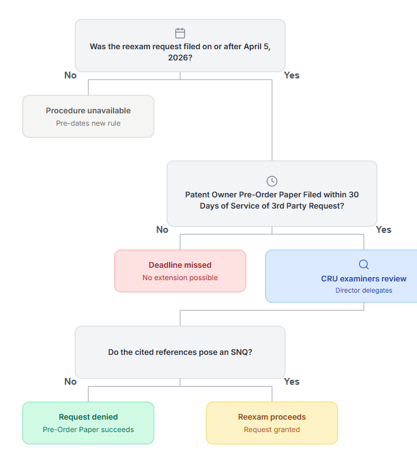
Check for statutory estoppel. If the requester previously challenged your patent through an IPR or post-grant review and a final written decision issued, the requester is barred by statutory estoppel from bringing the reexamination.[5][6] If estoppel applies, file a petition to terminate — the requester should not be allowed to take a second bite at the apple.
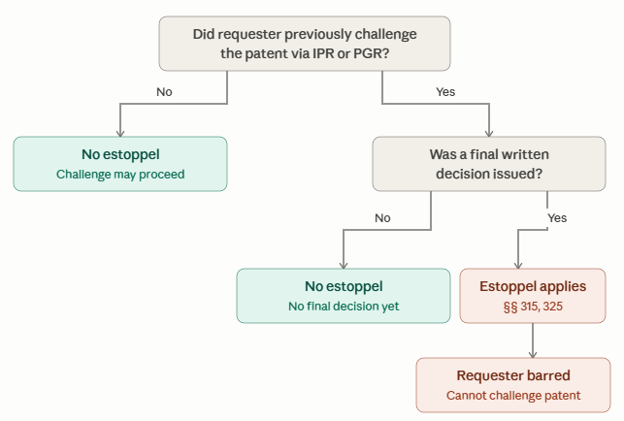
File a Pre-Order Paper to dispute the Substantial New Question requirement. To warrant an order granting reexamination, an ex parte reexamination request must raise a substantial new question of patentability (SNQ) concerning the challenged claims. Before the Office decides whether to order reexamination, you can file a Pre-Order Paper arguing that the cited references do not raise this substantial new question of patentability. The Director and delegates then decide whether the references in the request actually pose such a question. A few details make or break this option:
- It is a new procedure that applies to ex parte reexamination requests filed on or after April 5, 2026.[7]
- It must be filed within 30 days of the date the third-party requester served the reexamination request on you. That deadline is strictly non-extendable — miss it and the option is gone.
- It is reviewed by Director delegates: specially trained examiners within the USPTO's Central Reexamination Unit.[8]
- If it succeeds, the reexamination request is denied outright.
Petition Challenging the Order Granting Reexamination. After reexamination has been ordered, the patent owner may consider filing a petition under 37 C.F.R. § 1.181 asking the Office to set aside the examiner's decision ordering reexamination. As a practical matter, however, such a petition confronts a steep and usually insurmountable barrier, and it is unlikely to succeed.
Petitions challenging an order granting reexamination tend to fail for two reasons. First, 35 U.S.C. § 303(c) makes the determination that a substantial new question of patentability exists final and non-appealable. This means any petition attacking this determination asks the Office to review itself without accountability to a higher authority. Second, the patent owner already has a path to relief inside the reexamination proceeding by controlling claim amendments and arguments presented before the examiner. And if the examiner doesn’t agree, appeals can be made to the PTAB and Federal Circuit.
A petition may be appropriate when it targets a genuine procedural defect. Procedural defects include a request’s failure to meet filing date or fee requirements, or a clear procedural irregularity in how the order issued. On the other hand, petitions questioning SNQ findings are unlikely to prevail, even if the art was already considered or the art does not teach the claims.
Think Hard Before Filing a Patent Owner Statement
Once reexamination is ordered, you have the right to file a patent owner statement. Often, the better move is to skip it.
Forgoing the statement effectively denies the requester another chance to speak. File one, and you hand your opponent an automatic two-month window to reply, rebut, and pick at your patent all over again. A statement also forces you to lay out your defense early — handing the requester a roadmap and boxing you in if claim interpretations shift or if the dispute lands in district court.
In most cases, the smarter approach is to wait for the office action to issue. Conserve your best arguments for when the requester cannot comment on or mischaracterize them.
The Office Action Response Is the Best Chance for Success
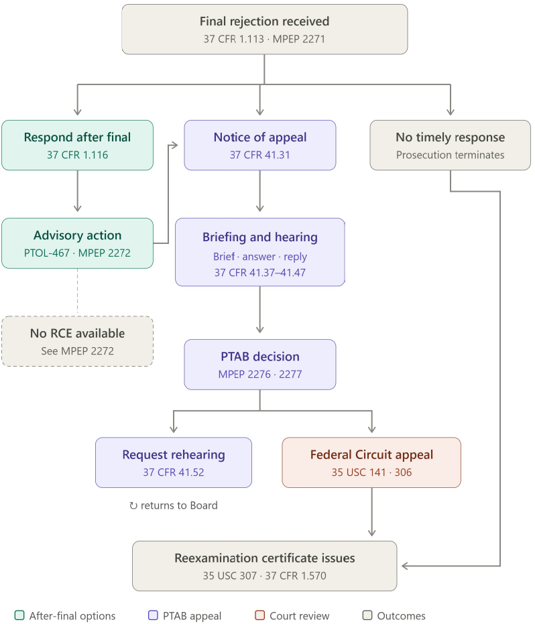
In reexamination, unlike ordinary prosecution, you cannot file a request for continued examination (RCE). Prosecution before the examiner in a reexamination is meant to conclude with the final action. If you forgo the patent owner statement, that compresses your opportunity to argue and make substantive amendments into the response to the first (non-final) office action. Once a final rejection issues, your right to further prosecution is limited.
After-final options are narrow and tightly governed. Once a final rejection issues, you have no right to amend finally rejected claims, add new claims, or reinstate canceled claims. Any after-final amendment is judged under the strict standards of 37 C.F.R. § 1.116 (and 37 C.F.R. § 41.33 once an appeal is filed), and it is entered only at the examiner's discretion. You may accept allowable subject matter identified in the final office action. You can present arguments to further develop the record and position the case for appeal. You are, at least, entitled to the examiner's ruling — typically an advisory action — before you are forced to file a notice of appeal. But the lesson is clear: the first response carries the weight of the proceeding.
Develop Your Claim Strategy
Because there is no second round, your claim strategy needs to be right the first time.
Front-load everything. Put your best claim amendments and strongest arguments into the first response. The familiar prosecution mindset of submitting a minimal amendment to see how the Office handles it is not advised.
Build fallback positions with new claims. You can add entirely new claims without canceling your original claims, which lets you build independent fallback positions — keeping your broadest claims while adding more defensible ones. Similarly, narrower claims can be secured that closely read on a competitor product.
Use dependent claims as a cascading ladder. Build a graduated ladder of dependent claims that layer in structural detail, formulas, and features drawn from the figures—each one anchored in the intrinsic record. Throughout, keep your eye on how a person of ordinary skill would objectively understand the claim terms in light of the specification, the prosecution history, and the rest of the intrinsic evidence.
Conclusion
Ex parte reexamination is enjoying a resurgence in popularity as IPRs become less attractive for patent challengers. As the IPR door narrows, it appears that ex parte reexamination is the validity challenge patent owners are most likely to face. Reexamination is a fundamentally different procedure from IPRs, and patent owners looking to survive the ex parte reexamination process should utilize strategies tailored specifically for the ex parte reexamination procedure.
ENDNOTES
[1] U.S. Patent & Trademark Office, PTAB Trial Statistics FY25 Q4, https://www.uspto.gov/sites/default/files/documents/Trial_StatsFY25_Q4.pdf.
[2] U.S. Patent & Trademark Office, Open Letter and Memorandum (Oct. 17, 2025), https://www.uspto.gov/sites/default/files/documents/open-letter-and-memo_20251017.pdf.
[3] U.S. Patent & Trademark Office, USPTO Advances Proposed Rule Governing Inter Partes Review (2025), https://www.uspto.gov/subscription-center/2025/uspto-advances-proposed-rule-governing-inter-partes-review.
[4] 35 U.S.C. § 305, https://www.law.cornell.edu/uscode/text/35/305.
[5] 35 U.S.C. § 315, https://www.law.cornell.edu/uscode/text/35/315.
[6] 35 U.S.C. § 325, https://www.law.cornell.edu/uscode/text/35/325.
[7] U.S. Patent & Trademark Office, USPTO Announces Pre-Order Procedure Regarding Substantial New Question (2026), https://www.uspto.gov/subscription-center/2026/uspto-announces-pre-order-procedure-regarding-substantial-new-question.
[8] U.S. Patent & Trademark Office, Central Reexamination Unit (CRU), https://www.uspto.gov/about-us/organizational-offices/office-commissioner-patents/central-reexamination-unit.
Authors

William A. Meunier
Member

Kevin C. Amendt
Member